Scuba diving hand signals
Updated 2026-07-01 · Skills & Safety
Because you can't speak underwater, divers communicate with hand signals — and knowing the core set is essential for safe diving. The most important thing to remember: the diving 'OK' is a thumb-and-forefinger circle, not a thumbs-up. Underwater, thumbs-up means 'go up' (end the dive), not 'good'.
You'll learn these in your course and use them on every dive. Here are the ones every beginner must know.
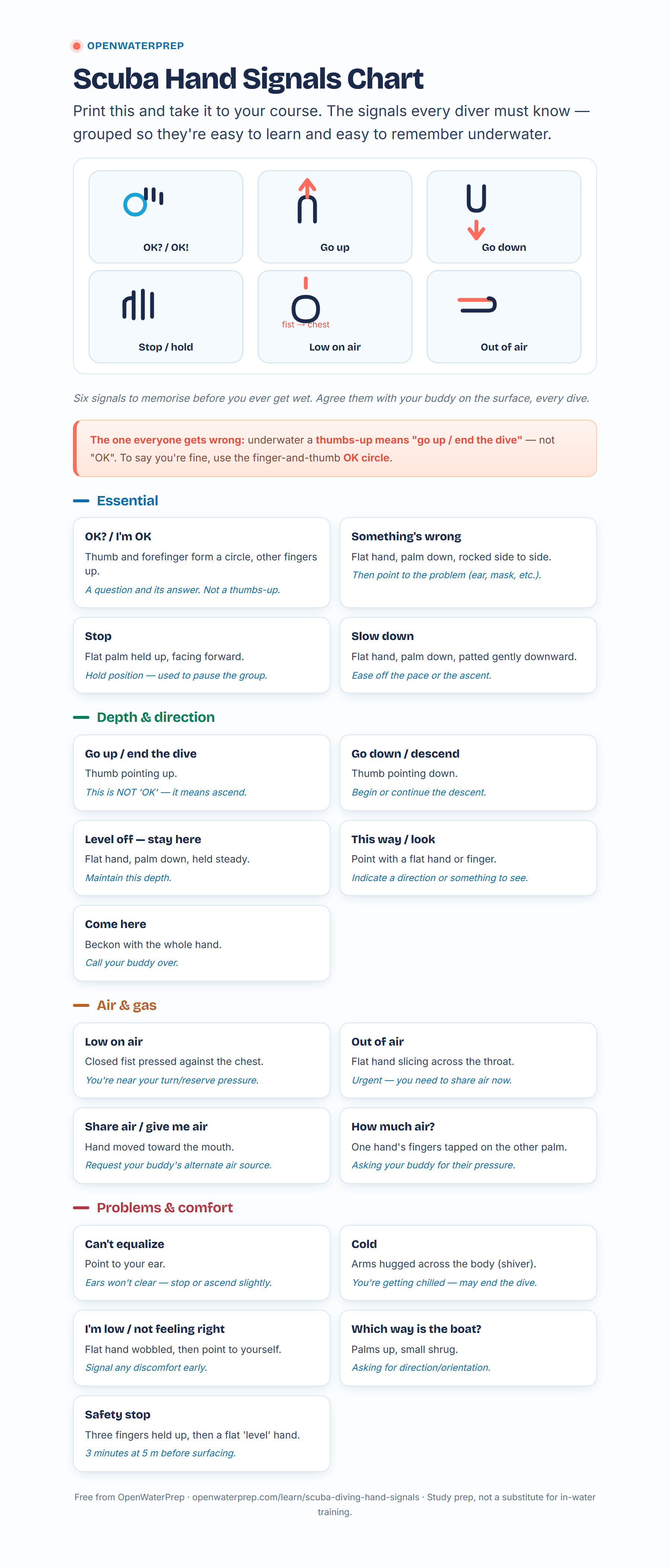
The essential signals
Master these before your first dive:
- ·OK — thumb and forefinger form a circle (a question and an answer: 'are you OK?' / 'I'm OK').
- ·Not OK / problem — flat hand, palm down, rocked side to side, then point to the issue.
- ·Go up / end the dive — thumbs-up.
- ·Go down / descend — thumbs-down.
- ·Stop — flat palm held up, facing forward.
- ·Out of air — a hand slicing across the throat.
- ·Low on air — a closed fist against the chest.
- ·Share air / give me air — hand moved toward the mouth.
Why 'OK' isn't a thumbs-up
This trips up new divers: on land a thumbs-up means 'good', but underwater it's a command to ascend. To say you're fine, always use the finger-circle 'OK'. Signals are also given as a question and echoed back as confirmation — if your buddy signals 'OK?', you reply 'OK' so they know you understood.
Frequently asked questions
What is the 'OK' sign in scuba diving?+
It's a circle made with your thumb and forefinger (the other fingers up). It's used both to ask 'are you OK?' and to answer 'I'm OK'. Importantly, a thumbs-up is not 'OK' underwater — it means 'go up / end the dive'.
How do divers say they are low on or out of air?+
'Low on air' is a closed fist held against the chest. 'Out of air' is a flat hand slicing across the throat — an urgent signal to share air with your buddy immediately.
Why don't divers use thumbs-up for 'good'?+
Because underwater the thumbs-up is reserved for 'ascend / end the dive'. Using the finger-circle 'OK' instead avoids a dangerous mix-up between 'I'm fine' and 'let's go up'.